· Blog · 6 min read
"Stop Sitting on the Sidelines": Five Questions With Dr. Kwadwo Kyeremanteng on His onix, His Book, and Why Healthcare's Best Chapter Is Still Ahead
The ICU physician on his new book, his onix, and why he would rather point people toward what is possible than dwell on what is broken.
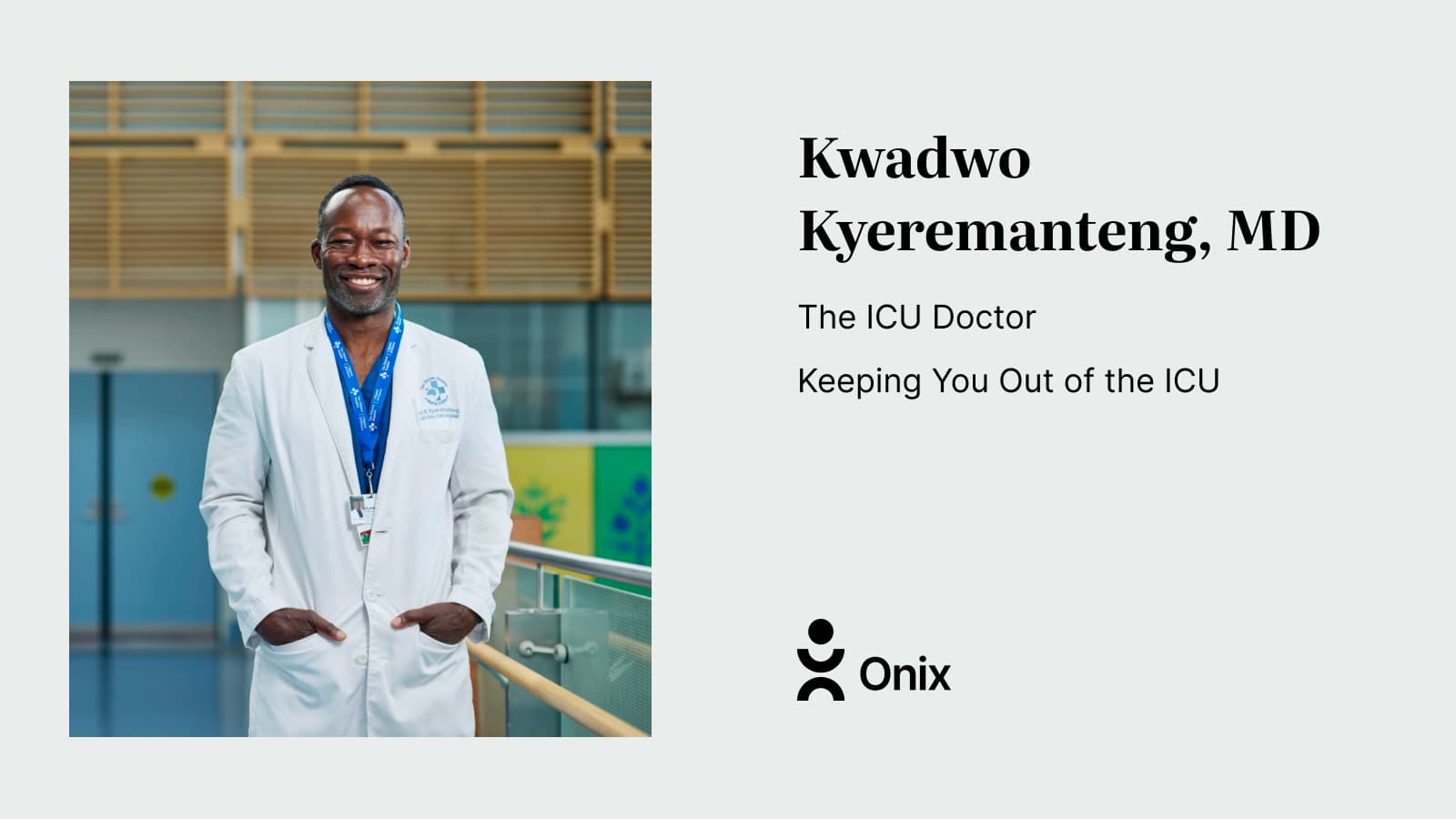
There’s a particular kind of person who spends years working in the ICU and comes out the other side more hopeful, not less. Dr. Kwadwo Kyeremanteng is one of them. Ask him about the state of healthcare right now and he won’t sugarcoat it: the wait times, the vanishing family doctors, the outcomes he watches unfold in real time when people can’t get help early enough. But sit with him for more than a minute and the tone of the conversation shifts. He has this way of turning a hard truth into a “here’s what we do about it,” almost as if he can’t help himself. It’s that same instinct that turned the doctor into a podcast host, a newsletter writer, and an author of multiple books, as well as a founding expert on Onix, where his own expertise, built from his work with his consent, now lives as something people can actually talk to.
We sat down with Dr. Kwadwo to talk about his onix, his new book, and why he’d rather point people toward what’s possible than dwell on what’s broken.
1. The people who most need your expertise often have the least access to it. What changes when it lives inside an onix?
Dr. Kwadwo: Not everyone gets access to that level of expertise and knowledge, and not in a format where they can go back and forth. If you’re watching a YouTube video, or reading a book, questions come up. You listen to a podcast and think, “He said this about protein intake, but what if I have this condition, or limitations in my diet?” The interactivity is the piece that changes everything. It lets you really map out a plan, or clear up something you weren’t sure about.
And to me, this is where the future of health is going. People are going to have their own expertise available to them, personalized, in a real way. You’ll go to your doctor in your lifetime with your diagnosis already in hand. You’ll know what’s going on. Your doctor will help navigate you through options and details. The whole dynamic of how we practice medicine and how you interact with your healthcare provider is going to be completely different, and I’d rather be ahead of that curve than watch it happen from the outside.
2. Say someone’s up at midnight with a symptom that isn’t quite ER-worthy, and their doctor’s next opening is weeks away. What do you want that moment to give them?
Dr. Kwadwo: We’re not fully there yet in terms of replacing a clinical visit, and I want to be honest about that. But if you’re having minor symptoms that feel like they don’t warrant an ER trip, and you want to talk through next steps, or figure out how urgently you need to see a provider, that makes a lot of sense right now.
Ideally, in the future, you’d be able to work through it and come out the other side saying, “I know what’s going on, I know I need to see my doctor, and I have a sense of what to expect.” That solves the access problem. It solves the issue of not being able to afford, or simply not having available a level of expertise to help you deal with your health. That democratization piece, the equity piece, is what gets me genuinely excited about platforms like this. I’d rather be part of building something with all the safety checks and methodology to make sure people are well-informed than have them rolling the dice on whatever open platform they stumble across at midnight.
3. There’s a version of AI in healthcare that strips out everything human about it. What made you want to build the opposite?
Dr. Kwadwo: Ideally, my onix is an extended version of me. You get my perspective, because every doctor is going to be slightly different. I work in an ICU, and me and a colleague will see eye to eye 90% of the time. But there’s a 10% variance on certain conditions, and some of that I feel very strongly about.
Take protein intake. Ask most dietitians how much protein someone needs, and they’re going to give you a number lower than what I’d say. I’m a true believer in hitting 0.7 to 1 gram per pound of ideal body weight. Do that consistently, and magical things happen. You get stronger, you feel fuller, your blood sugar stabilizes, your energy goes up, your cravings drop. Your body composition shifts. You just start winning. That’s a position I’ll go to the mat for, and that specificity is what I want reflected in my onix.
4. All of this (the onix, the interactivity, the personalization) traces back to a book. You could have called it Problems in Healthcare. What made you go with Opportunities instead?
Dr. Kwadwo: We’ve just seen years of trying to approach things with the same solutions, and they’re not working. Throw more money at it, cut this area, make sure we have savings here, and we go through the same cycle. Right now, I’ve never seen healthcare as bad as it has been in my career. In terms of wait times for surgery, the lack of primary care access. People don’t have family doctors, and I see the results of that on a regular basis, how long they’re waiting, emergency wait times, negative outcomes in the ICU because of how prohibitive the system has become.
But the exciting part is that I’m actually seeing, through technology and health innovation, real solutions to the problems we’re having. Instead of sitting on the sidelines and just complaining about it, I’m telling people there are opportunities now. Let’s get behind them. Let’s have less resistance to change and get excited, because we can actually see people have better outcomes because of what’s available right now.
5. What do you want someone to actually walk away doing, after they’ve read the book and talked to your onix?
Dr. Kwadwo: It depends on who you are. If you’re a thought leader, an administrator, a policy person, an entrepreneur in the space, you’re going to come away with something I’d call hope with agency. The sense that you can actually influence how things go, not just within the system, but within your own company, your own community.
The key theme across everything I’ve written is that you’ve got the power to make the change. We’re fatter and sicker than we’ve ever been. Baby boomers are hitting the age where they need healthcare the most. We’re spending an insane amount and getting inconsistent results. This is a time for change, and we can actually do it if we approach it the right way. What I want people to walk away with is that it’s possible. We’ve never needed that message more than we need it right now.
Dr. Kwadwo Kyeremanteng is an ICU physician, podcast host, and the author of the forthcoming Opportunities in Healthcare: Innovations, Solutions, and a Path to a Healthier Future for All. His expertise is available as a founding expert on Onix.